DSE English Candidates Lose Marks by Misusing Sophisticated Vocabulary; Obvious Grammar Errors in Oral Exam
🔥 Afraid of missing the latest open days, admissions information and application dates for primary and secondary schools across Hong Kong? Follow Goal-EDU.com now!
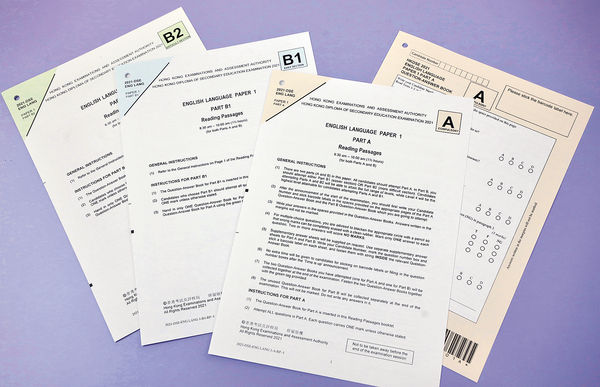
The DSE English Language oral examination has attracted much attention. The latest Question Papers and Marking Schemes report records many issues in candidates' performance: weaker candidates failed to accurately pronounce the endings of plural nouns or past-tense verbs, lacked eye contact with other candidates, and some misused sophisticated words or phrases, even making obvious grammar errors, including countable and uncountable nouns such as "Many money" or "Spend times with parents." Candidates are urged to speak more English in daily life.
👀 Lack of Eye Contact; Hesitant Speech
In English Paper 4 "Speaking," the report reflects that candidates had more problems in group discussions. Weaker candidates often spoke in a faint voice, were hesitant when speaking, and clearly failed to accurately pronounce the "s" in plurals such as "Classes" and "Spaces," and the "ed" endings of past-tense verbs such as "Skilled" and "Fixed." Other common problems included lack of eye contact with other candidates, failure to use common fixed phrases to show one's stance or indicate having finished speaking, such as "How about you?" and "We are on the same page," or giving brief responses, and insufficient or even irrelevant examples when explaining their stance.
❌ Misuse of Sophisticated Vocabulary; Obvious Grammar Errors
The report further noted that some candidates incorrectly used sophisticated words or phrases, including "Exobritant" (exorbitant), "Ubiquitous," and "Let's jump on the bandwagon," and even made obvious grammar errors, including countable and uncountable nouns such as "Many money" or "Spend times with parents," subject-verb agreement such as "Some restaurant is," and passive voice "Will drive my robots." Some candidates even said "Robotaxi can change the technology," losing marks for unclear meaning.
💡 Paper Chairman: Unfamiliar with Topic? Read Materials and Ask Questions
The paper chairman suggested that candidates unfamiliar with a topic should try reading the materials and ask questions during discussion to clarify uncertainties: "Asking other candidates questions during discussion is part of effective discussion." He also reminded candidates to read more English materials related to popular culture, recent hot topics, and local and international current affairs to strengthen speaking performance.
📖 Reading Paper: Failure to Follow Questions; Writing Paper: Memorised Text Mixed In
For other papers, the report on Paper 1 Reading noted that candidates should closely follow the question instructions rather than answering with their own knowledge; some candidates answered "the difference between bubble tea and coffee" with content not provided in the passage, such as "bubble tea contains less caffeine than coffee." Paper 2 Writing contained a lot of memorised text; the paper chairman said frankly that such text is "particularly conspicuous, may not directly address the question, and is generally easy to spot." Some candidates, when writing short stories, could only use simple and repetitive adjectives such as "sad," "really happy" or "so beautiful."
🎧 Paper 3 Listening: Grasp Word Meanings; Do Not Copy Materials Directly
As for Paper 3, which assesses listening and integrated skills, the report reminded candidates to pay attention to question requirements. Some candidates lost marks for failing to accurately convey key details from the recording, and should grasp the meaning of words when listening rather than making guesses. Candidates should note the headings of the notes pages, working guidelines and materials to clarify what information is needed while listening, and when writing should not directly copy the materials but synthesise them in their own words: "When necessary, transform raw statistics and data into generalised conclusions or arguments."